Is it Wrong to Make Animals Work for Us?
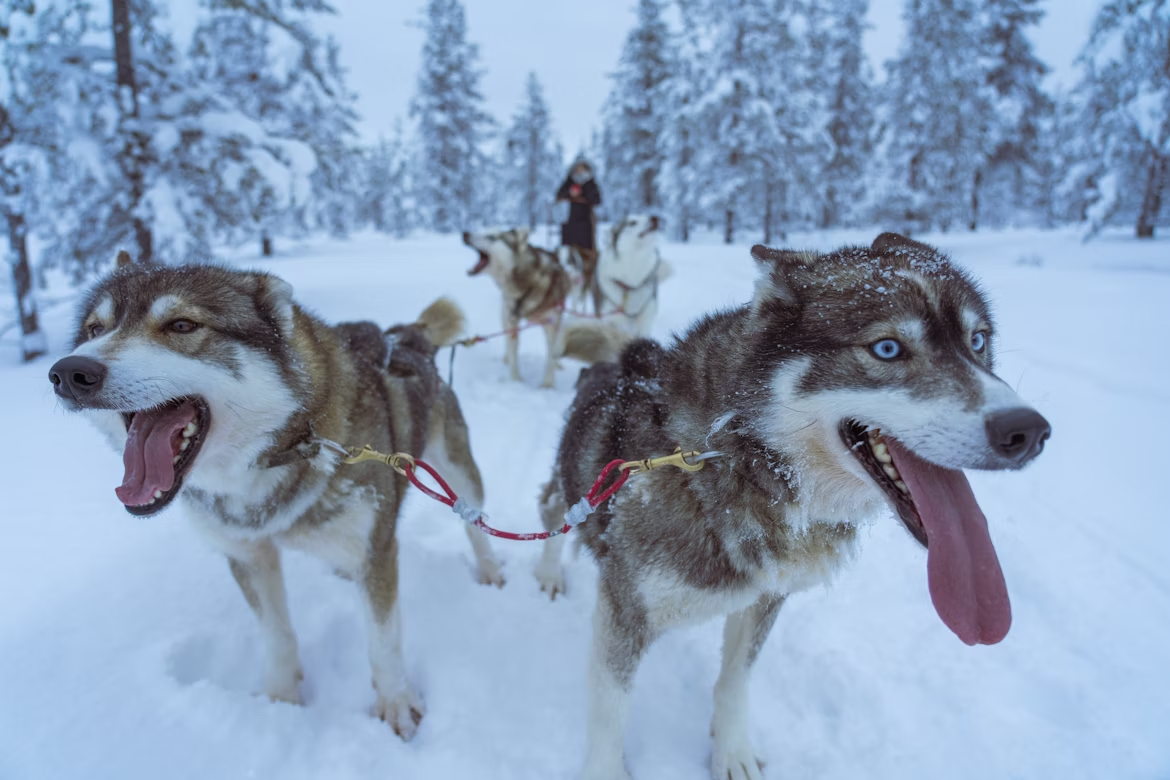
In debates about the ethical dimensions of using nonhuman animal labour, people increasingly argue that some forms of labour are compatible with animals’ interests, including their interests in freedom. The reason for this is that animals can choose to cooperate with us and choose to work for us. These choices manifest themselves in the animals’ informed enthusiasm for the activity, and this affirmation is considered especially significant when the animal has meaningful opportunities for dissent but chooses not to take them up. Under such circumstances, some suggest that we can interpret the animal’s wilful engagement as a form of consent. Examples of the kinds of jobs that animals might consent to – compatible with their basic interests, like not being harmed – are some forms of human therapy, conservation work, sporting activities, and non-invasive research.
I disagree. I have argued elsewhere that an animal’s willingness to engage in discrete activities and interactions within a role is not sufficient to show that they consent to the role itself. Here I want to try out a different argument: the fundamental problem with making animals work for us is that it typically involves us usurping their purposive will and harnessing their bodily powers to achieve human-given ends.
Freedom: Choosing and Pursuing One’s Own Ends
To make this case, I will draw on the work of Arthur Ripstein, who develops a powerful account of freedom as mutual independence (see especially Force and Freedom (Harvard University Press 2009)). Ripstein’s central idea is that freedom is the right to be master of your own life, which means pursuing ends that you choose, not ends chosen for you by others. As Ripstein argues in an earlier paper:
“You are independent if you are the one who decides what ends you will use your powers to pursue, as opposed to having someone else decide for you. You may still mess up, decide badly, or betray your true self. You may have limited options. You remain independent if no one else gets to tell you what to do. Each of us is independent if neither of us gets to tell the other what to do.
This interest in independence […] is a distinctive aspect of your status as a person, entitled to set your own purposes, and not required to act as an instrument for the pursuit of anyone else’s purposes. You are sovereign because no one else gets to tell you what to do; you would be their subject if they did.”1
Ripstein’s general framework is unfriendly to nonhuman animals (and indeed many human ones!) because of its Kantian foundations. At base, only human beings with the rational capacity to reflexively set their own ends should be granted the status of being independently free. It is the fact that we can critically reflect on our ends, normatively evaluate them, and revise them in light of new evidence or reasons, that we have a special claim to be masters of our own lives.
Consequently, a major challenge to granting nonhuman animals this type of independence is the idea that their purposiveness – their capacity to act toward goals – is fundamentally different from human freedom. Critics argue that animal ends are not freely chosen but are simply the result of innate natural urges. In short, they are seen as beings driven by instinct who lack the capacity for reasoned deliberation.
Of course, what animals can and cannot think about is an empirical question, and it’s doubtful that individual animals give no thought to what they’re doing. Evidence abounds of animals problem-solving, cooperating, manipulating and deceiving others, and making reasoned choices about where to live, where to go, who to hang out with and so on. It’s hard to make sense of that evidence without recognising that those animals are discriminating, reasoning agents.
Why Reflexive Rationality is Not Necessary
That said, one may nonetheless continue to worry that animals cannot set their own goals. Yes, they can adapt and respond to a changing environment and manipulate the world to satisfy their wants and needs, but ultimately, they have no control over the wants and needs they are oriented towards. They cannot reflect on their ends in the ways that some humans can. However, even if we grant this, I cannot help but wonder why it matters.

Individual beings who are subjects of a life, matter in and of themselves. It is in virtue of our subjectivity – our capacity to experience the world from our own unique, embodied point of view – that being subject to the will of another is a problem. As wilful creatures who have preferences, desires, and who experience things as salient to us, it is only fitting that we should exercise control over our lives. This is true for all wilful creatures who experience their embodiment in a way that no other can; for whom the pains, joys, anticipations, strivings, and satisfactions are felt uniquely.

It doesn’t matter whether such creatures can think about the shape of their entire life or whether they can think reflexively about their ends. Those capacities are beside the point. What matters is that they are embodied, feeling, purposive creatures who have a right to determine how their bodily powers will be used in pursuit of the ends that they seek to satisfy.
Rethinking Our Mastery Over Animals
This is why making animals work for us is problematic. It involves us using the bodily powers of other animals in a way that constitutes an unwarranted physical and psychic interference with their right to be self-determining. When we make animals labour to our ends, we, in Ripstein’s terms, usurp their powers, we get them to act for our purposes; to do something that they otherwise would not have done. In practice, this usually involves selective breeding, extensive training, discipline, and habituation. Moreover, making animals work for us is often a form of domination – irrespective of how willingly they may go along with it – because we treat other animals as though their agentic bodily powers were something that we have a right over. This assumed mastery over other animals is incompatible with their status as morally independent beings who matter in their own right and who have a right against us supplanting their wills with our own.
Of course, for many of the animals who labour for us, or who depend upon us for the satisfaction of their daily needs, freedom as independence from us is currently out of reach. But these reflections on freedom challenge the idea that the imposition of social roles upon animals in human-animal communities is neutral, or that human ends are somehow baked into the natures of some animals – a claim that is sometimes made about herding dogs, sniffer dogs, assistance animals, and so on. It also puts pressure on the idea that their enjoyment or enthusiasm can constitute consent to human-defined goals. Moreover, it invites us to think more critically about the ways in which our current uses of animals deform, constrain, and deny their agentic powers.
- Ripstein, Arthur. “Beyond the Harm Principle.” Philosophy & Public Affairs, vol. 34, no. 3, 2006, pp. 215–45. JSTOR, http://www.jstor.org/stable/3876391. ↩︎



Loved this!