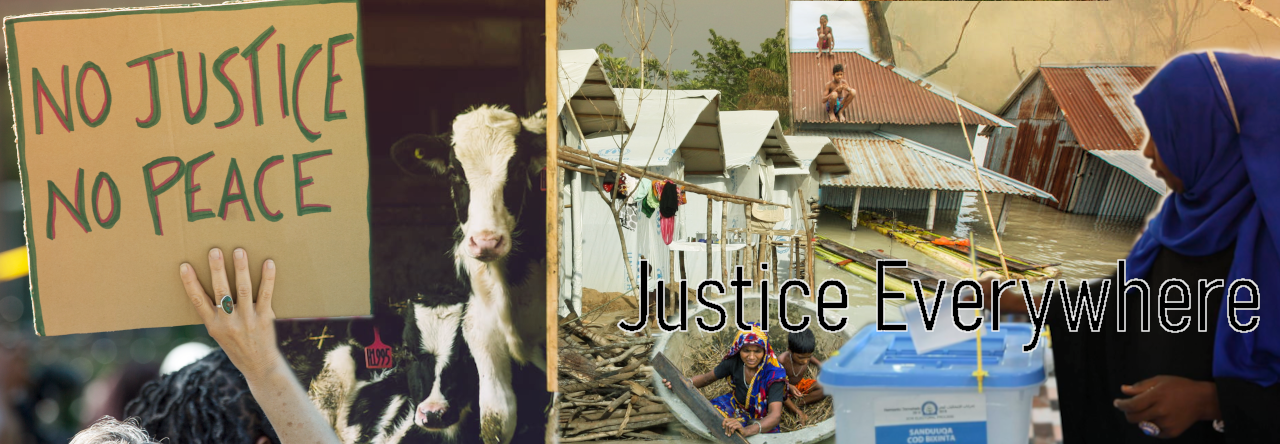
Why Our Attitudes to Animal Minds Matter for Justice
In human relationships, we often operate with the ‘benefit of the doubt’. When a friend cancels a plan or a family member behaves differently to normal, we might assume there is something going on that has little to do with us. Although we might be uncertain, we operate on a presumption that works in their benefit.
By analogy, our fundamental attitude to the subjective lifeworlds of other animals ought to begin with a presumption that works in their benefit, too: that there is a somebody there to be socially engaged with. Like the benefit of the doubt, such a presumption of subjectivity ought to exist even in the face of uncertainty concerning the extent and kind of subjectivity animals possess.
Yet, rather than being a social grace, assuming that animals are somebodies is necessary for justice in social relations with them to even get started. We must see animals as somebodies to see them as belonging to our social worlds. Indeed, this presumption goes radically beyond an acknowledgement (already common to animal ethics) that animals have morally important interests. To see why, we need to start by looking at our traditional attitude to animal minds.

Attitudes to Animal Minds
A presumption of subjectivity would fly in the face of scientific – and, as a byproduct, many cultural – norms. Much thinking towards animals has been shaped by the idea that we should adopt a sceptical null hypothesis: scientists assume that animals lack purported traits and characteristics, until proven otherwise.
In this way, our scientific and cultural imaginations are infused with the notion of the ‘minimal’ animal: the biological and behavourist view of animals as ‘mindless automatons’.[1] The trouble is that this mechanistic view prevents an accurate understanding of other animals. Not only does it generate a problematically high bar for science – which must then prove beyond its own version of reasonable doubt that someone is home – but it means we get off on the wrong foot in relating to animals. We fail to do justice to them before we have even started.
This is the exact opposite of how we engage with other humans. When you bump into someone you do not know in a coffee shop, you do not treat them as a mindless zombie until proven otherwise. For most of us, our first instinct is to recognise that they too have a lifeworld and a perspective that we might engage with. Of course, not all cultures have operated with this impoverished view of animals. For instance, Nuu-chah-nulth accounts of tsawalk present a worldview in which animals figure as spiritually significant agents. Yet for the most part, contemporary cultures are infused with a sceptical caution towards animal minds.
This contrasts with the way our brains are hardwired. Imagining that the dog enjoys catching the frisbee she is chasing helps us to meaningfully make sense of the world. But it also enlivens our social reality. If we assume the cat is purring in contentment when she receives a scratch, then it satisfies our deeply entrenched social needs – irrespective of species.[2] We are wired to connect. The presumption of subjectivity asks us to give in to that impulse, rather than resisting it.
What is a somebody?
To be a ‘somebody’ is more than just being a biological entity that reacts to stimuli. It is to be a being who experiences the world, and intentionally acts within it. And recognising this is more than just acknowledging that animals have interests. It would be a shift-change in the very way we imagine our social worlds.
Research by the RSPCA shows that we humans tend to perceive the animals we most frequently engage with as sentient. Yet, while 94% of us believe dogs are sentient, that number drops significantly for less familiar animals like rats (two-thirds) or carp (less than half). Many scholars have picked up on this. As I pointed to in a previous post, there is a growing consensus concerning animal sentience in academic circles. And philosophers have argued that we ought therefore presume that animals are conscious and morally considerable.[3]
But the missing piece is intentional agency. Although agency might not matter in its own right,[4] if an animal is sentient their intentional agency is paramount. Several philosophers have established its value and moral importance.[5] Yet, as far as I am aware, no one has argued that a similar basic presumption should extend to the existence of agency in other animals.
Adopting a more complete presumption of subjectivity – one that includes sentience as well as intentional agency – might be contentious. But it is crucial. Many of us do not tend to give animals’ choices much importance in our decision making. For instance, although dogs get stressed when petting is forced, it is common to see humans touching them without first asking permission.
This suggests we need a perspective change as a matter of social justice. Animals should be thought of as bearers of lifeworlds, filled with thought, feeling and intention, until (and only if) proven otherwise. As with the benefit of the doubt, this presumption does not derive from certainty regarding existing evidence – quite the contrary. Even if we have doubts about its extent and character, we should think and act as if animals have a subjectivity; one that comprises sentience and intentional agency i.e. a complex perspective. Precaution speaks in favour of this.
Interspecies Justice
There are at least three reasons why this is important for human-animal social relations. Although these are only the tip of the iceberg, I’ll have much more to say about this topic in future writing.
First, our social interactions with others depend on the kinds of capacities, interests and needs that they have. Social relations are delicate negotiations between two beings. If we remain closed off to animals’ subjectivity, we cannot listen to what they are telling us. Presuming that animals are somebodies counteracts this: it reinterprets a service dog’s stubbornness or a horse’s resistance not as a ‘training failure’ to be corrected, but as a legitimate expression of fatigue, discomfort, or a ‘no’ that should carry weight. Without this presumption, we fail to see social relations with animals as negotiated interactions.
Second, even if some (or perhaps most) animals might lack an awareness of social status, this has important impact on their interests (Pablo Magaña and Devon Cass also discuss this in a recent post). Many of our interests are in socially positioned goods such as adequate opportunities, access to resources, and safety. A lack of recognition of subjectivity can mean we lose the adequate social positions needed to access these goods. Consider pigs: by categorising them as sources of meat rather than somebodies, we assign them social positions that deny them safety, disregard their most basic choices, and sacrifice their very lives for the sake of our palates. Elevating animals’ social status by seeing them as somebodies recalls the well-known vegetarian moto that animals should be ‘friends not food’.
Lastly, our attitudes towards others also fundamentally shape the space – both literal and figurative – that we are willing to give them. In his insightful article on respect, Leslie Green argues that ‘thoughtlessness is one of the familiar modalities of disrespect in the modern world’. When it comes to animals, this could not be truer. Recognising animals’ subjectivity forces us to see the behaviour of urban wildlife (such as a squirrel denning in a loft, or pigeons claiming a town square), as a claim to a social space. These animals are not villainous pests to be controlled, but individuals trying to stake out their lives. This perspective forces us to recognise animals for what they should already be: fully fledged members of our social worlds.
[1] Sue Donaldson and Will Kymlicka draw this idea from Dominque Lestel in their recent book, Animals and the Right to Politics, 10-14.
[2] See also research by Epley et al: here, here, and here.
[3] Among others, Jonathan Birch and Jeff Sebo have defended this claim.
[4] My view is that only sentience does.
[5] See work by e.g., Sue Donaldson & Will Kymlicka, Nicolas Delon, Richard Healey & Angie Pepper, Susana Monsó et al, and Marc G. Wilcox.