Student Protests and the Fleeting Community in New Delhi
The principle of community is certainly not new, yet it names something rarely discussed about our social relations. The natural objection follows: it would be wonderful if the baker baked and the teacher taught out of a commitment to fulfilling others’ needs. But isn’t it self-indulgent to think a society could run on trust in each other’s attitudes of service?

I have now discussed G.A. Cohen’s principle of ‘community’ with three cohorts of undergraduate students. The principle is simple yet radical. It requires that ‘I serve you not because of what I can get out of doing so but because you need my service.’ Market activity, Cohen argues, is governed by fear and greed, teaching us to see others as sources of enrichment, or as threats. Both are horrible ways of seeing people.
Students’ first reaction is usually the same as the one I had when I came across the text. The principle of community is certainly not new, yet it names something rarely discussed about our social relations. The natural objection follows: it would be wonderful if the baker baked and the teacher taught out of a commitment to fulfilling others’ needs. But isn’t it self-indulgent to think a society could run on trust in each other’s attitudes of service?
Cohen’s camping trip thought experiment, laid out in his book Why Not Socialism?, is a good first response. It would be odd if people on a camping trip shared pots, pans, a soccer ball, or cards only out of fear or greed. It is easy to imagine a camper sharing a ball because it would help others enjoy the trip more. It would in fact be quite strange for the camper to expect fellow campers to pay them for the use of their soccer ball. Of course, it would be quite normal for them to expect that other campers share their goods in a similar fashion. However, that’s still different from the camper sharing the ball only if they derive some immediate benefit in return. When community is at work, they would be willing to share the ball even when they don’t really want the other person’s pans, cards or whatever else it is that they are able to offer. The thought experiment makes the idea that strangers can share goods and services out of a concern for others feel a little less wacky.
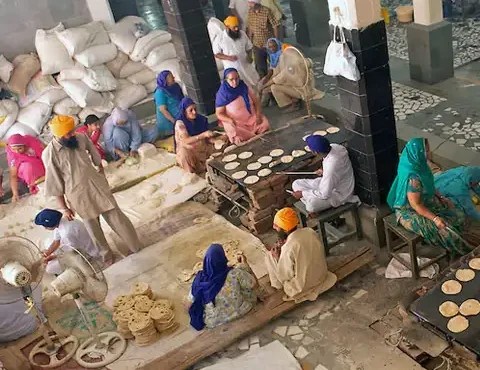
Another example is the langar at Sikh gurdwaras: communal meals shared with all who visit. The biggest langars, such as the one at the Golden Temple, serve meals to over 100,000 people a day, run entirely by volunteers, who cook, clean, and serve without any immediate rewards or punishment. So there are pockets in society where something like the community principle already operates, suggesting we all carry a propensity to be generous, alongside our propensity for self-interest. As Cohen puts it, we know how to run an economy on self-interest. We do not know how to run one on generosity. Is generosity strong enough to power whole systems of production?
I am inclined a bit more towards ‘a yes’ after following the student demonstrations in Delhi over the past two months. They were started by the Cockroach Janta Party, or CJP, a satirical youth movement, joined by student organizations and tens of thousands of students from across the country. The key demand was the resignation of the Union Education Minister, over irregularities in national entrance exams. Paper leaks had affected millions of students, forcing exam cancellations and lengthening the wait to enter college or find work. For many, clearing these exams is their only visible route to stable income and upward mobility. When the stakes are this high, a breakdown in the exam system understandably breeds anger. Other issues fed the mobilization too: underemployment, unemployment, and rising inequality, pressures that have been building among India’s youth for years. But I am less interested in why the protests happened, and more in how they unfolded.
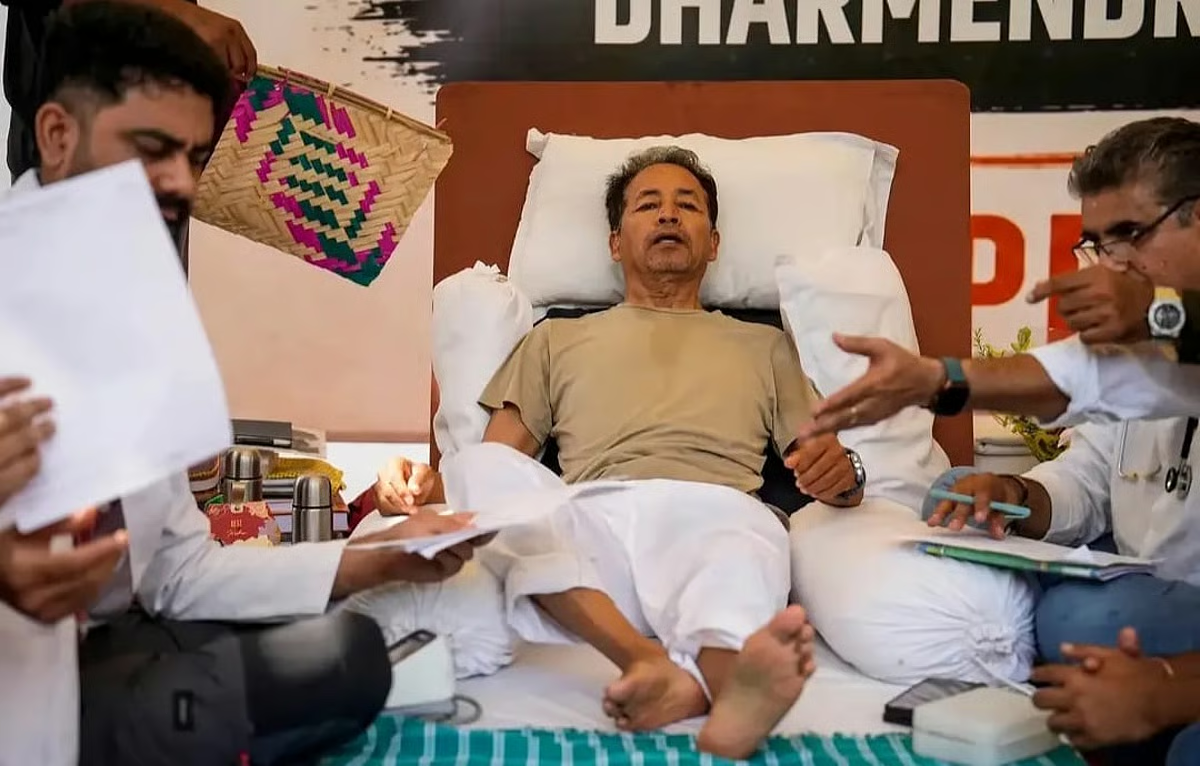
CJP is not a registered party. It remains a satirical, youth-led movement, and although the protest was called by CJP’s leaders, the way it unfolded was itself fairly decentralized. For a while, Sonam Wangchuk, an engineer and activist, became the face of the movement after starting an indefinite hunger strike on June 28, backing the demand for the minister’s resignation. On July 18, 2026, after twenty days of fasting, police forcibly removed him from the site and admitted him to hospital. The crowds only grew after that, peaking on July 20 for a planned march to Parliament.
The protest site sits in the heart of Delhi, a two-kilometre stretch of posh cafes, street hawkers, a large park, upmarket shops, five-star hotels, government offices, and museums. Normally, it is hard to find water or a chair to sit on in this area without paying for them in some form. The park and pavements are about the only spaces not gated by money or restriction. Class lines are quite vivid: one class brunches lazily in air-conditioned restaurants, another sells plastic sunglasses on the street, another waits outside Starbucks for spare change. Then there are the Very Important People, moving in and out of government offices in Very Important white cars. On crowded days, seasoned Delhi-goers move their phones to their front pockets and hold their bags closer. Women carry a longer checklist: avoid unnecessary eye contact, keep emergency contacts ready, maybe sidestep crowded areas entirely. When interacting with others, an individual usually wears the hat of a buyer, a seller, an officer, a citizen, a someone keeping others in line, a someone being scolded and conditioned to stay in it.
During the demonstrations, the place transformed. It was business as usual in many parts but the public space felt larger, and community, in Cohen’s sense, seemed to come alive. Protesters occupied Jantar Mantar, Delhi’s designated protest site, but eventually the crowds spilled well beyond it, especially on July 20. Many stayed for days at the site, through heat and rain, some joining Wangchuk’s fast. When tens of thousands of people, across classes, gather like this, new questions arise. Where does food and water come from? Where does waste go? How is the crowd managed so it doesn’t turn into a stampede? Who looks after someone who faints in the heat, or keeps spirits up so the crowd doesn’t thin from fatigue? Ordinarily, the market and the state answer such questions, each with its usual flaws. The market excludes anyone who cannot pay. The state’s monopoly on force often backfires. Neither was equipped here. If anything, the protests were bad for business (many shops had to shut) and worse for a state bent on keeping order near its leaders. The state made its displeasure known with internet blackouts, water cannons, beatings, surveillance and arrests.

And yet solutions appeared, even if imperfect – for food, water, waste, crowd management, and emergencies, all outside the market and the state. Strangers distributed food and water through delivery apps and other channels, with instructions to hand it to anyone at the site. At one point there was a surplus of meals, and student protesters shared the extras with patients’ families outside a nearby hospital. Volunteers took turns to pick up litter and clean the area regularly. Complete strangers looked out for each other. Many women reported an unusual sense of security, even in a crowd this size, in the heart of Delhi. One testimony is particularly telling: “If this had been any other crowd, I would have run away. But I felt so safe. No one was looking at you differently. The stares we’re so used to, they just weren’t there.” If someone fainted, there was always someone to rush them to hospital. An independent journalist recounted a moment facing police violence when unknown men formed a human chain around her so she could keep recording safely. Some offered their art to keep the crowd’s spirits up. One offered to paint the Indian flag on my cheek. At the time, I only had a banana to offer her, and that was enough. People gave what they could, without much thought for what they’d get back. It was the other person’s need, not their ability to pay or use force, that mattered.

Walking away, I wondered why this spirit of community couldn’t sustain our societies more broadly. As a good philosopher, I immediately entertained doubts and objections. Would it work without a shared goal like, in this case, the demand for the education minister’s resignation? Could people sustain this attitude of service for years, not days? How long before ambition, greed, or the need for status crept back in? I am still unsure whether community, in Cohen’s sense, can become central enough to push fear and greed out of our socio-economic relations. But as Cohen argued, we have no reason to exclude it as a normative demand. Sadly, that demand was largely missing from this protest’s discourse, which stayed focused on the unfairness of the exam system. The movement would do well to name community as one of its demands. It has, after all, already shown what that looks like in practice.
Note: An earlier version of this article stated some of G.A. Cohen’s claims somewhat imprecisely. I thank Anca Gheaus for bringing this to my attention



In a society which operates out of scarcity, people have no option but to be dependent on community, and are thus incentivized for sharing resources.
As India progresses, gradually but surely, from scarcity to abundance, the reliance on others reduces for individuals. When one doesn’t “need” the community, are they incentivized to provide for those in the community who do?