Category: Democracy

What’s wrong with an epistocratic council?

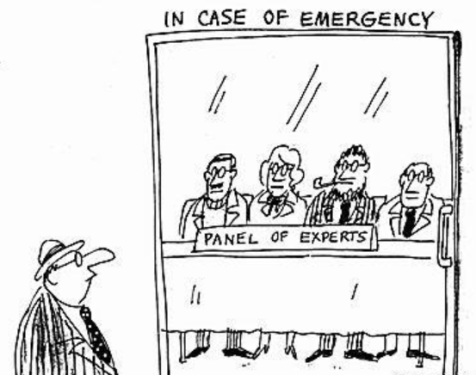
Résultat de recherche d'images pour "experts cartoon"

Why do we trust experts to take care of our health and not to take care of our interests in the political realm? This is a very old question of democratic theory. Epistocracy is a neologism frequently used in recent works to refer to a form of government by those who know more or are wiser than the mass.

Two different aspects might differentiate an epistocracy from a democracy: the absence of political equality in the selection of the rulers, or the absence of egalitarian accountability. In addition to these undemocratic aspects, an epistocracy would differ from other non-democratic regimes by some mechanism allowing people who distinguish themselves from the mass by their wisdom or expertise to rule or at least enjoy an important degree of political power. The best example and – to my knowledge – the most interesting challenge to our democratic convictions is Jason Brennan’s idea of an “epistocratic council”. Members of this council would be selected on a meritocratic basis, passing a competency exam. And all citizens would have an equal voice in the choice of the expertise criteria.

Leaving aside the practical challenges such as the choice of the people in charge of preparing the exam, what would be wrong with such an epistocratic council? (more…)
What, if anything, is wrong with private money in political philosophy?

Recently, there have been increasing worries about the role of private money that funds libertarian political philosophy (see e.g. here or here). The role of private money in academic research is not precisely a new problem; it has plagued other fields for decades (see e.g. here for a study of some of the more problematic forms). But it seems to be rather new for political philosophy, or at least it seems to have gone to levels it has not had in the recent past. But what exactly is wrong with it? Isn’t it simply an exercise of freedom of expression to use one’s money to sponsor scholarship one is interested in?

(more…)

Should ‘We’ Take Seriously the Worries of Voters of the Alternative For Germany?

September’s general elections have brought Germany its own Brexit/Trump moment. For the first time since 1945 a far right nationalist party is part of the German national parliament. The Alternative for Germany, AfD, gained 12,6 % of German votes. Given the AfD’s increasing popularity in the polls and the resurging nationalism over the last years this wasn’t a shock moment in the way that Brexit or Trump’s election was. Yet, there is something particularly troubling about seeing Nazis back in the German parliament. One common response is that ‘we need to take the worries of the AfD voters more seriously’. They have been overlooked and here we are. But: What does it mean ‘to take seriously’? And who is this ‘we’ that is supposed to take seriously? (more…)

From the Vault: Good Reads on Democracy and Politicians

While Justice Everywhere takes a break over the summer, we recall from our archives some of our memorable posts from 2016-2017.

Here are four good reads in democracy and politicians that you may have missed or be interested to re-read:

Aveek Bhattacharya’s ‘What should voters look for in their politicians?

Jesper Pedersen’s ‘Should MPs be subject to mandatory deselection?

Miriam Ronzoni’s ‘Germany and European Solidarity

Luke Ulas’ ‘Why are you more angry about Trump’s state visit to the UK than about visits from leaders of China and Saudi Arabia?

Germany and European Solidarity (or Lack thereof!): Why We Need the Right Kind of Leader

… and why Schulz could be the one

Saying that the right thing to do is for Germany to show more solidarity towards the European South is hardly news. But how can this be achieved in times of populism? In spite of the odds, Martin Schulz (the Chancellor candidate of the SPD) could play a surprisingly refreshing role in this respect.

(more…)

More Solidarity among EU Citizens

From June 14th to June 16th, the Amsterdam Centre for Contemporary European Studies (ACCESS EUROPE) organised an international conference on “Solidarity and European integration”. In his contribution to the panel “European solidarity and justice: normative issues”, Andrea Sangiovanni presented his dispositional analysis of the concept “solidarity”. He defines solidarity as a (complex) disposition to sacrifice one’s own self-interest (narrowly understood) for the good of others. In order to distinguish solidarity from utilitarian altruism, love, enlightened self-interest, and fairness, he further specifies it as being a disposition to sacrifice that is impersonal, narrow, and person-directed. It is a disposition to sacrifice one’s own self-interest for the sake of overcoming an adversity faced by other member states or EU citizens. Such a dispositional analysis is, I believe, much more promising than, for instance, an analysis of solidarity as a mental state. It enables us to reach a better understanding of the conditions that are most conducive to the development of solidarity and the factors that hinder it. In this post, I develop some thoughts on how to address this issue in the European context. (more…)

If everything is measured, can we still see one another as equals?

Relational egalitarians hold what matters for justice is that all members of a society “stand in relations of equality to others.” The idea that all human beings are moral equals is widely shared: it underlies the Universal Declaration of Human Rights and many national constitutions. How will this norm be affected by the arrival of “big data,” the collecting and analysing of huge amounts of data about individuals? Internet companies and government services collect data about individuals’ activities, including geographic locations, shopping behaviour and friendships. Many individuals voluntarily share such information on social media, some also track their physical activities in meticulous details. Experts expect that “people analytics” – big data applied to the measurement of work performance – will have a revolutionary impact on labour markets.

(more…)

There is too much division of labour: Against all-or-nothing social roles

Marx might have been right, too strict a division of labour is making us worse off in an important respect: we cannot but fail to develop core human abilities, and this failure cannot but affect our sense of wellbeing, of being at home in the world. Not that we should, or could, fully undo the division of labour such that you and I can “hunt in the morning, fish in the afternoon, rear cattle in the evening, criticise after dinner, just as I have a mind, without ever becoming hunter, fisherman, herdsman or critic.” But is it really unavoidable, or good for us, to have to live by a radical division of labour where the main social roles are an all-or-nothing business?

Consider: you either enter politics, dedicating it a large amount of time, or you have virtually no say in any public affairs. You’re either a parent or someone who can have children in their lives only very sporadically and precariously. You typically either have a full-time job (for many over-engulfing) or an unsatisfying one, which you can all too easily lose, and which probably doesn’t pay enough to live. You’re either in a monogamous relationship, or else your relationship(s) are not socially sanctioned as serious, meaningful, worthy of protection – as marriage and civil partnerships are.

(more…)

Evidence for a non-ideal theory of freedom of expression (Remembering Anna Politkovskaya)

About ten years ago Anna Politkovskaya, a well-known Russian journalist, writer and human rights’ activist, died in her apartment building in Moscow, shot four times in a lift. After a long and highly charged trial-and-retrial, we still do not know who the instigators of Politkovskaya’s assassination are, though six people have been convicted of the murder. In her books and articles (she was one of the best reporters of Novaya Gazeta), Politkovskaya reported on the situation in Chechnya during the Second Chechen War and on the deterioration of the quality of Russian democracy, especially as far as human rights protection, transparency and good governance were concerned. She defined contemporary Russia ‘a failing democracy’ and she admonished her fellow citizens about the concrete risks of ‘hurtling back into a Soviet abyss’, thanks to the ‘information vacuum’ that the Russian power system was able to produce. Her investigative works as well as her popularity in the West – she won several important awards from human rights and international journalism and her books were translated in several languages – were certainly worrisome for the Russian government as well as for several crucial state agencies. In Russia, however, her influence was quite limited beyond human rights activists’ circles, as Vladimir Putin noticed after her brutal assassination.

(more…)